

Can You Really Recover in 10 Minutes as a Busy Professional?
Last Updated: October 26, 2026
Quick Summary
Quick recovery routines for busy professionals insert strategic recovery moments into your day to combat sitting, stress, and fatigue. You can recover in 10 minutes through a structured combination of light walking, static stretching, and targeted muscle relaxation.
- A 10-minute recovery routine combines 2 minutes of light walking, 3 minutes of static stretching, and 3 minutes of massage gun work.
- Static stretching held 20-30 seconds is most effective for desk work targeting neck, shoulders, lower back, and hip flexors.
- Daily low-intensity recovery produces better long-term outcomes than weekly intensive sessions, according to sports science research.
- Start with desk stretches alone for one week, add active recovery exercises in week two, then add massage gun work in week three.
- Anchor your recovery routine to an existing habit like after morning coffee, at lunch, or right after work.
Table of Contents
- Why Quick Recovery Routines Matter for Busy Professionals
- Active Recovery Exercises You Can Do Anywhere
- Desk Stretches for Professionals to Release Tension
- Your 10-Minute Recovery Routine: A Step-by-Step Plan
- Why Quick Recovery Routines Matter for Busy Professionals
- Getting Started With Your Recovery Routine
- Frequently Asked Questions
Why Quick Recovery Routines Matter for Busy Professionals
You can recover in 10 minutes as a busy professional, if you're intentional. Quick recovery routines for busy professionals insert strategic recovery moments into your day to combat sitting, stress, and fatigue. Research on sedentary work from the American Heart Association shows regular movement breaks maintain better physical performance throughout the day.
Active Recovery Exercises You Can Do Anywhere
Active recovery exercises are low-intensity movements that promote blood flow without adding stress: a 10-minute walk, 5-8 slow lunges per leg, controlled arm circles, 10-15 bodyweight squats, and glute bridges held one second at the top. Guidelines on active recovery from the American College of Sports Medicine emphasize that low-intensity movement supports muscle adaptation and recovery. The Portable Muscle Relaxation Massage Gun with 5+ Speed Gears pairs well with active recovery.

Desk Stretches for Professionals to Release Tension
Desk stretches target the areas office work punishes most: neck, shoulders, lower back, and hip flexors, no need to leave your workspace. Static stretching, holding 20-30 seconds, is most effective for desk work. Try a neck stretch (20 seconds per side), 10 slow shoulder rolls each way, a seated spinal twist (20 seconds per side), a wrist and forearm stretch (20 seconds per arm), and a half-lunge hip flexor stretch (20 seconds per side); the full set takes under five minutes, twice daily. The Yoga Stretch Band for Flexibility, Stretching and Mobility adds gentle resistance. For neck and shoulder tension, the Intelligent Cervical & Shoulder Massager with Heat and 3 Massage Modes offers a customizable massage experience with 42°C heat, three modes, 15-minute auto shut-off, and a USB rechargeable battery. Occupational health research on postural strain documents that desk workers experience measurable increases in neck and shoulder tension throughout the day.

Your 10-Minute Recovery Routine: A Step-by-Step Plan
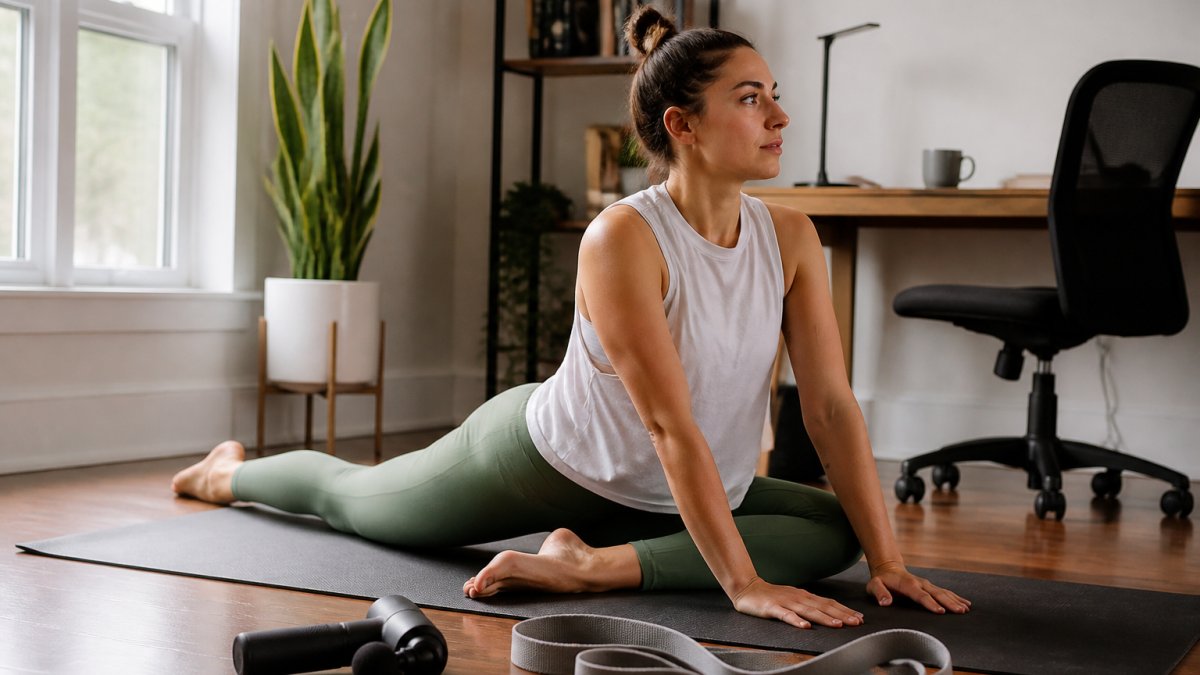
A structured 10-minute recovery routine combines active recovery, static stretching, and targeted muscle relaxation.
Portable Muscle Relaxation Massage Gun with 5+ Speed Gears →
| Step | Duration | Activity | Focus Area |
|---|---|---|---|
| 1 | 2 minutes | Light walking or gentle movement | Increase circulation |
| 2 | 3 minutes | Static stretching (neck, shoulders, hips) | Release tension |
| 3 | 3 minutes | Massage gun or hand massage | Accelerate recovery |
Minutes 1-2: gentle walking primes your muscles. Minutes 3-5: your five desk stretches, 20 seconds each. Minutes 6-9: the Portable Muscle Relaxation Massage Gun with 5+ Speed Gears on legs, back, and shoulders, start low, 30 seconds per muscle group. Minutes 9-10: slow breathing (inhale four, hold four, exhale four) resets your nervous system.
Why Quick Recovery Routines Matter for Busy Professionals
Recovery isn't luxury, it's maintenance. Quick recovery routines for busy professionals solve a real constraint: time, you can't commit to two-hour sessions, but you can commit to 10 minutes. Sports science research on recovery frequency demonstrates that daily low-intensity recovery produces better long-term outcomes than weekly intensive sessions. Effective home self-care tips for busy professionals include anchoring recovery to an existing habit, after morning coffee, at lunch, or right after work. Equipment matters less than you think: bodyweight, a yoga mat, and a stretch band are enough to start.
Getting Started With Your Recovery Routine
Start with the stretching phase alone: one week of the five desk stretches, twice daily. Week two, add active recovery exercises. Week three, add the massage gun phase if you have the equipment. The Effective Home Self Care Tips for Busy Professionals guide adds complementary strategies, sleep hygiene, hydration, and stress management. Your 10-minute recovery routine bridges sedentary professional work and the active lifestyle you want, it's about showing up consistently.
Frequently Asked Questions
What is a good 10-minute active recovery routine for busy professionals?
A solid 10-minute recovery routine combines light movement, stretching, and targeted massage. Start with 2 minutes of gentle walking or arm circles to warm up, spend 5 minutes on static stretching (holding each stretch for 20-30 seconds), and finish with 3 minutes of foam rolling or massage gun work on major muscle groups. The key is consistency: even 10 minutes daily beats sporadic longer sessions. Use tools like the Portable Muscle Relaxation Massage Gun ($38.99).
Can desk stretches for professionals actually help with neck and shoulder tension?
Yes. Neck and shoulder tension from sedentary desk work builds up from sustained posture strain. Simple desk stretches, neck rolls, shoulder shrugs, and seated spinal twists, release muscle tightness immediately. Pair stretches with a device like the Intelligent Cervical & Shoulder Massager ($42.99), which combines heat and multiple massage modes. Even 2-3 minutes of stretching every 2 hours prevents tension from accumulating.
Do massage guns actually work for muscle recovery?
Massage guns provide percussion massage. They should be used for 30-60 seconds per area at a comfortable speed setting. The Portable Muscle Relaxation Massage Gun features five adjustable speed gears and four interchangeable heads, letting you customize intensity for different muscles. Results are most noticeable when used consistently after workouts or during active recovery days.
How long should an active recovery session last for someone with a tight schedule?
Effective active recovery sessions range from 10-20 minutes for busy professionals. A 10-minute routine works if it includes movement, stretching, and light massage. Longer sessions (15-20 minutes) allow time for deeper stretching and more thorough muscle work. The important factor is frequency, three to four short sessions per week beats one long session. Even 10 minutes of consistent active recovery can be a beneficial part of your routine.
