

Best Resistance Bands for Home Strength: 2026 Review
Table of Contents
- Why Resistance Bands Beat Weights in Small Apartments
- Quick Comparison: Best Resistance Bands for Home Strength
- Muscle Recovery & Fitness Bundle: The All-in-One Apartment Kit
- Squat Resistance Band Set: Best for Lower-Body Strength on a Budget
- Elastic String Fitness Resistance Rope 11 Piece Set: Best for Workout Variety
- Latex Material Yoga Fitness Resistance Belt: Best for Tension Customisation
- Yoga Stretch Band: Best for Mobility and Recovery
- Slimming Buttock Lifting Tension Rope Pilates: Best for Glute and Core Work
- How to Choose Resistance Band Tension for Your Fitness Level
- Resistance Band Exercises for Beginners: Start Here
- Frequently Asked Questions
Last Updated: September 27, 2026
Why Resistance Bands Beat Weights in Small Apartments
A 2026 survey from the American College of Sports Medicine fitness trends report found that home workouts remain one of the fastest-growing fitness categories, and it's easy to see why: commutes to the gym eat time that busy professionals don't have. This guide from FitGlow Fitness Gear breaks down the best resistance bands for home strength in 2026, with real specs, honest trade-offs, and picks for every budget.
Resistance bands are elastic training tools that create external load through stretch rather than gravity, which makes them ideal for small spaces. Unlike dumbbells, they store in a drawer, cost a fraction of a full rack, and won't crack your floorboards when you drop them.
The case for bands in an apartment comes down to three things: footprint, noise, and cost. A full set of bands occupies less space than a single pair of 20kg dumbbells. There's no dropping, no clanging, and no vibration through the floor into your downstairs neighbour's ceiling. The NHS physical activity guidelines note that adults should aim for strength work on at least two days per week, and bands let you hit that target without a gym membership.
Below, we'll show you exactly how to pick the right bands for your floor plan, fitness level, and budget.
Quick Comparison: Best Resistance Bands for Home Strength
Here's the short version. For most apartment dwellers who want one purchase that covers strength, mobility, and recovery, the Muscle Recovery & Fitness Bundle is the best resistance bands set on this list. It's the only kit here that pairs training bands with recovery tools, so you're not buying twice.

| Product | Price | Best For | Standout Feature |
|---|---|---|---|
| Muscle Recovery & Fitness Bundle | $135.99 | All-in-one training + recovery | Loop bands, tube, discs, trigger ball, roller stick |
| Squat Resistance Band Set | $20.99 | Lower-body work on a budget | Polyester-cotton tension band with carry bag |
| Elastic String 11 Piece Set | $28.99 | Workout variety | 11 pieces, TPE material, storage bag |
| Latex Yoga Fitness Belt | $18.99 | Tension customisation | 5 resistance levels, 15lb to 35lb |
| Yoga Stretch Band | $34.99 | Mobility and recovery | Skin-friendly material, all fitness levels |
| Slimming Buttock Lifting Tension Rope | $43.99 | Glute and core work | Folding pole plus 30lb bands per strip |
The rest of this review goes deeper on each pick, including who should skip it.
Muscle Recovery & Fitness Bundle: The All-in-One Apartment Kit
If you only buy one thing this year, make it this. The Muscle Recovery & Fitness Bundle is the most complete home strength kit in the FitGlow Fitness Gear range, and it's the pick I'd hand to anyone starting from zero in a small flat.
What's in the box matters here. You get a three-pack of loop resistance bands for legs, hips, and glutes, a 5-foot upper-body stretch band, a 4-foot exercise tube with a latex inner tube with fabric covering to those allergic to latex, sliding core discs that work on both carpet and hardwood, and a silicone trigger point ball.
That's strength training and recovery in a single purchase. The discs are the sleeper hit: the shiny side grips carpet, the soft side grips tile or wood, so you can train core stability without scratching your floor.
Best for: anyone who wants a full home gym setup in one box and doesn't want to think about compatibility.
The drawback: at $135.99 it's the priciest option here. If you only want bands and nothing else, the cheaper picks below cover you.
Squat Resistance Band Set: Best for Lower-Body Strength on a Budget
Twenty-one dollars for a squat band set with a carry bag is hard to argue with, and this is the pick for anyone whose main goal is legs and glutes.
The Squat Resistance Band Set is a polyester-cotton tension band designed for squat and lower-body work. It packs into its included bag, which matters in a studio flat where every item needs a home. There's no metal hardware to scratch floors and no assembly.

Where it fits: pair it with bodyweight squats, glute bridges, or lateral walks. The band adds resistance through the whole movement, which is exactly what you want for hip and glute activation.
Best for: beginners building a lower-body routine and renters who want zero floor risk.
The drawback: it's a single band, so it won't cover upper-body pulling or mobility work. If you want one purchase for everything, look at the bundle instead.
Elastic String Fitness Resistance Rope 11 Piece Set: Best for Workout Variety
Variety is what keeps a home routine alive past week three, and this 11-piece set is built for exactly that.
The Elastic String Fitness Resistance Rope 11 Piece Set uses durable TPE material and comes in a military green gradient finish with a storage bag. The 11 pieces let you swap attachments and resistance for different movements: strength training, stretching, running drills, and body shaping. It's compact enough for a cupboard shelf and light enough to take outdoors.

The TPE construction is worth noting if you train barefoot or in socks. It's flexible, and the set is designed for daily use rather than occasional sessions.
Best for: people who get bored doing the same three exercises and want options without buying five separate products.
The drawback: 11 pieces means 11 things to keep track of. In a tiny flat, the storage bag isn't optional, it's essential.
Latex Material Yoga Fitness Resistance Belt: Best for Tension Customisation
Progression is the hardest part of band training. A band that's too light stops challenging you within weeks, and this belt solves that with five distinct resistance levels.
The Latex Material Yoga Fitness Resistance Belt comes in 15lb (yellow), 20lb (red), 25lb (blue), 30lb (green), and 35lb (black). That's a proper progression ladder: start light, move up as you get stronger, and you won't need to rebuy. The TPE material is lightweight and flexible, and it's designed for yoga, stretching, strength training, and body shaping.
If you're wondering how to choose resistance band tension, this is the cleanest answer on the list: buy the level you can complete 12 to 15 controlled reps with, then move up one colour when that feels easy.
Best for: anyone who wants one band they can grow with rather than a drawer full of mismatched levels.
The drawback: you buy one level at a time, so full customisation across all five colours costs more than a single set.
Yoga Stretch Band: Best for Mobility and Recovery
Strength training without mobility work is a fast track to stiff shoulders and a tight lower back, especially if you sit at a desk all day.
The Yoga Stretch Band is designed for flexibility, range of motion, muscle strength, and recovery support. It's suitable for yoga, Pilates, physical therapy, and daily stretching, and the material is described as durable and skin-friendly. It works for beginners, athletes, and seniors, which tells you the resistance is manageable rather than punishing.
Muscle Recovery & Fitness Bundle →
Use it for shoulder dislocates, hamstring stretches, and hip openers. Ten minutes after a workout keeps the range of motion you just trained for.
Best for: remote workers with tight necks and shoulders, and anyone pairing strength days with recovery days.
The drawback: it's a mobility tool first. Don't expect it to replace a heavier band for progressive strength work.
Slimming Buttock Lifting Tension Rope Pilates: Best for Glute and Core Work
Glute and core training usually needs either a machine or a lot of floor space. This kit needs neither.
The Slimming Buttock Lifting Tension Rope Pilates uses a natural latex tube with nylon and a steel buckle, built around a folding fitness pole that's 93cm long with a 100cm adjusting belt. Each resistance band delivers 30lb of tension, and the set includes handles.
The 30lb per band rating puts it in genuine strength territory rather than light toning. Expect to feel it in glutes, hamstrings, and core stabilisers.
Best for: people who want targeted glute and core work without a machine or a gym membership.
The drawback: it's a specialised tool. If you want one purchase that covers your whole body, the bundle is the better call.
How to Choose Resistance Band Tension for Your Fitness Level
Match the band to your current strength, not your aspirational strength. That's the whole rule, and most people get it backwards by buying the heaviest band they can find. In an apartment, there's a second rule: buy for storage and noise, not just tension. A 35lb band you can't anchor safely is worse than a 20lb band you actually use.
Use this starting framework:
- Complete beginner or returning after a break: start at 15lb. You should finish 12 to 15 reps with two reps still in reserve.
- Training consistently for three to six months: 20lb to 25lb for upper body, 30lb for lower body.
- Experienced lifter new to bands: 30lb to 35lb. Bands feel different from free weights, so expect an adjustment period.
- Rehab or mobility focus: stay light. The Yoga Stretch Band and the 15lb belt level are built for this.
Two signals tell you it's time to move up: you can complete your top set without effort, or you're adding reps past 20 to feel anything. Both mean the band has stopped providing a training stimulus.
The apartment-specific part most guides skip: tension level and storage footprint are linked. A five-level belt set (15lb to 35lb) takes up roughly the same drawer space as a single heavy loop band, because the bands are flat and stack. A tube-and-handle set with clips and carabiners takes two to three times the space and rattles when you move it. If you're in a studio or a shared flat, flat bands and belts win on storage every time.
Noise by tension level: heavier bands don't make more noise on their own, but heavier tension encourages faster reps and harder anchors, which is where noise comes from. If you train above someone, cap your working tension at the level where you can still control the eccentric (lowering) phase for two seconds. That keeps the band from snapping back and slapping the floor or door.
Renter's buying sequence, if you don't want to guess:
- Buy one mid-range band first, 20lb or 25lb, and test it against your actual anchor (door, table leg, or strap).
- If the anchor holds and the tension feels right, add the next level up rather than replacing the first one.
- If the anchor slips or the band feels too heavy to control, drop a level before you buy anything else. A band that sits unused because every set feels like a fight is a common mistake.
Storage reality check: a five-level belt set folds into a shoebox. An 11-piece tube set needs its storage bag or it becomes a drawer of loose clips. A single squat band with a carry bag hangs on a hook behind a door. Before you buy, decide where the band lives when it's not in use, if you can't answer that in one sentence, you'll end up with gear on the floor.
If you're unsure, buy one mid-range band first and add levels later. Guessing heavy is a common mistake, and it can end with a band that sits unused because every set feels like a fight.
Resistance Band Exercises for Beginners: Start Here
Most beginner band routines assume you have a spare room. This one assumes you have a 6x6 foot patch of floor between the sofa and the coffee table, roughly the size of a yoga mat plus arm's reach. Every exercise below fits inside that footprint, and none of them require drilling, a door anchor that damages the frame, or a partner.
Start with this full-body resistance band workout, three days per week with a rest day between sessions. Rest 45 to 60 seconds between sets. The whole session takes about 25 minutes.
- Band chest press (loop band behind your back, press forward): 3 sets of 12. Stand facing away from the sofa so the band doesn't snap into furniture if your grip slips.
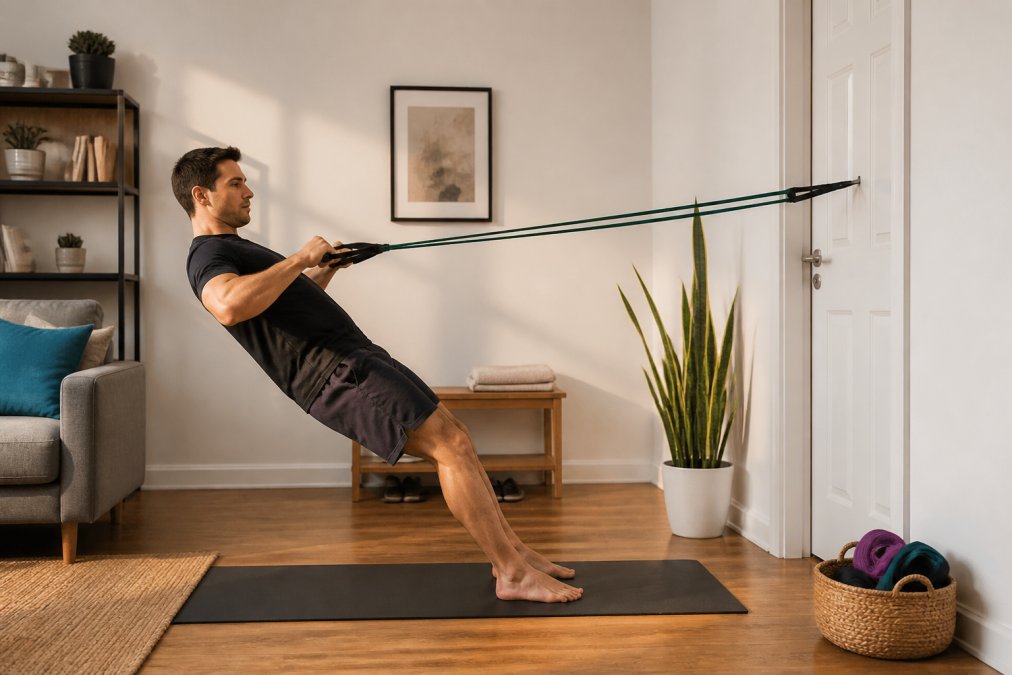
- Band row (anchor to a closed door at the hinge side, pull toward your ribs): 3 sets of 12. If you rent and don't want to risk the frame, loop the band around a sturdy table leg or a closed interior door handle instead, see the anchoring note below.
- Squat with band above knees (push knees out against the band): 3 sets of 15. This is the quietest lower-body option you have; no jumping, no dropping, no vibration through the floor.
- Glute bridge with band (band above knees, drive hips up): 3 sets of 15. Do this on a 6mm to 8mm dense foam mat, not a thin yoga mat, to cut impact noise for downstairs neighbours.
- Band pull-apart (hold band at chest height, pull apart): 2 sets of 15. Keep elbows soft; this is the single best antidote to desk-related shoulder tightness.
- Band deadlift (stand on band, hinge at the hips): 3 sets of 12. Stand on the band with both feet shoulder-width apart so it doesn't roll under your arch mid-rep.
The 6x6 foot layout: mat in the centre, bands and tube in a basket at one corner, door anchor or table-leg anchor at the edge of the mat. That's the entire gym. When you're done, the mat rolls up and the basket goes on a shelf, under 60 seconds to clear.
Rental-friendly anchoring, three options that don't require drilling:
- Closed-door anchor: loop the band over the top of a closed door on the hinge side, then close the door firmly. Test with a light band first. Never anchor on the handle side, the door can pop open mid-rep and the band snaps back fast.
- Table-leg anchor: loop the band around a heavy table or desk leg and sit or kneel facing it. This is the safest option for renters because nothing touches the wall or door.
- Door-hinge strap anchor: a padded nylon strap that sits in the hinge gap and closes into the door. No screws, no adhesive, no marks. Most hardware stores and online fitness retailers sell these for under $15.
Noise and floor protection: the two things that generate complaints from downstairs neighbours are dropped weights and vibration, not band tension itself. Bands are already quiet, but two cheap additions make them quieter: a 6mm to 8mm dense foam mat under your standing area (not a thin yoga mat, those compress flat and transmit impact), and felt pads under any furniture you anchor to. If you train early morning or late evening, skip any plyometric variation and stick to the six exercises above.
Where does FitGlow Fitness Gear fit into a routine like this? The bundle covers every exercise above plus recovery, which is why it stays the top pick for a first purchase. If you'd rather build up gradually, start with the Squat Resistance Band Set and the Yoga Stretch Band, then add the bundle later.
Frequently Asked Questions
Are resistance bands as effective as weights for building strength?
Resistance bands create progressive tension that challenges muscles through a full range of motion, similar to free weights. Research shows they can build strength and muscle when you train consistently and increase tension over time. The key difference is the resistance curve: bands get harder as you stretch them, while weights feel heaviest at the start. For home strength training, bands offer a portable, joint-friendly alternative that minimises pressure on your joints compared to weight-training exercises.
How do I choose the right resistance band tension for my fitness level?
Start with a lighter band and focus on completing 12 to 15 controlled repetitions with good form. If the last two reps feel challenging but doable, that tension is right for you. For lower-body exercises like squats, you may need a heavier band than for upper-body moves. FitGlow Fitness Gear's Latex Material Yoga Fitness Resistance Belt comes in five levels from 15lb to 35lb, so you can progress gradually without buying a whole new set.
Can you build a full home gym using only resistance bands?
Yes. A well-chosen set of resistance bands can cover every major muscle group: chest presses, rows, squats, lunges, shoulder presses, bicep curls, and core work. The Muscle Recovery & Fitness Bundle includes loop bands, an upper-body stretch band, an exercise tube, sliding discs, and recovery tools, giving you a complete strength and mobility setup in one purchase. Add a door anchor and you can replicate most gym exercises without bulky machines.
What is the best way to store resistance bands in a small apartment?
Hang them on a wall hook behind a door, roll them into a small storage basket, or use a over-the-door organiser. The Elastic String Fitness Resistance Rope 11 Piece Set comes with its own storage bag, which keeps everything contained and makes it easy to tuck into a closet or under a bed. Avoid leaving bands in direct sunlight or extreme heat, as this can weaken the material over time.
How do I keep resistance band workouts quiet for neighbours below?
Place a thick yoga mat or foam tiles under your workout area to absorb impact and reduce vibration. Choose exercises that keep your feet planted, like banded squats, rows, and presses, rather than jumping movements. The Sliding Core Exercise Discs in the Muscle Recovery & Fitness Bundle work smoothly on carpet or hardwood without thumping. For added floor protection, a dense exercise mat under your standing area makes a noticeable difference.